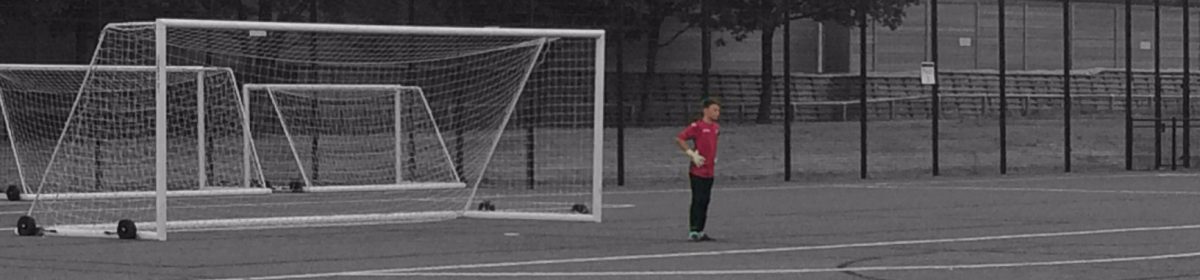
So, after my lad had been unsuccessful in his trial, I continued trying to get the academy’s feedback on his performance. Regardless of whether he is interested in having another trial at an academy or continues to play grassroots football, the feedback is important for him to be able to improve on whichever areas of his game have been highlighted as requiring remedial work.
It was looking increasingly unlikely that I was going to receive any feedback at all as the days passed. I was either being ignored or received the occasional text message to say somebody would be in touch. I assumed that they were taking as long as they were because of how many different elements of goalkeeping they would be giving feedback on.
After eight weeks at the academy, I guessed they must have looked at all the different qualities and skill sets that are required to be a goalkeeper and compared that to his performance to come to their final decision.
Having been a keeper when I was (much) younger, then recently completing my FA level 1 goalkeeper coaching badge and also coaching my lad for the last couple of seasons, I had a stab at what I thought would be the categories of the feedback. Starting off simple, there were things that could be as basic as; set position (broken down into its individual parts), handling technique, shot stopping, positioning. Although, these are all fairly standard skills that any keeper who has been invited to trial would be expected to have a decent level of ability with. Alternatively when watching a player, the scout would have seen these attributes for themselves but either way you would expect the triallist to display a decent level of competence.
Footwork is a vital part of goalkeeping, even more so as the game of football and (specifically) the position of goalkeeper evolves. The advent of keepers becoming the extra defender when required and therefore being comfortable with the ball at their feet, has meant much more emphasis on ‘ball mastery’. So I was expecting sections on; ball skills (first touch, how comfortable on the ball etc), distribution (short, medium and long distances and accuracy), kicking technique (dead balls, side-winders etc). Part of the distribution section would probably also include throwing (again, short, medium and long distances and accuracy).
I also expected athleticism and speed to figure in any feedback given. In my mind, these two headings count a fair bit for keepers. Athleticism and speed can cover; agility, reactions, bravery, speed of footwork (explosive movement etc), spring/leap, dealing with crosses/high balls.
Decision making is also an area that is key to being a competent goalkeeper. In this area you could include; communication with team mates, when to come out/when to stay, general mindset/mindset under pressure (the making of one mistake doesn’t lead to another etc).
The physical attributes of the player as they develop over time are also likely to have a huge bearing on how far the young goalkeeper may or may not progress. There are plenty of goalkeepers with most, if not all, of the right attributes to be able to play football at a high level but through a lack of height, their chances will be dramatically reduced. This is no doubt one of the more difficult areas for the academy to assess, as height (and weight) would have to be projected estimates, based on factors such as the keeper’s current height, weight and age, possibly taking into account their parent’s heights. Even with these details, growth spurts may (or may not) occur which will obviously have a bearing on the height of the individual.
All the goalkeeping attributes I’ve mentioned fall into sections within the FA’s ‘four corners’ approach to coaching. The headings are: Technical/Tactical, Psychological, Physical and Social. At his initial meeting at the academy, there was a great deal of emphasis placed on the social aspect while he was on his trial period. In other words, they wanted him to be fully involved and interact with the academy lads while he was there. We were left in no doubt that even with all the other elements in place, a failure in this area would most likely mean an unsuccessful outcome, so I obviously thought this would play quite a large part in the feedback he received.
After numerous requests for feedback over about 10 days with no results, I sent a text message to the Lead Coach. At this point, if he didn’t give any feedback, or didn’t respond, I decided that I would draw a line under it and move on. I didn’t want to, as the whole point of it was to understand why my lad had been unsuccessful and to use it as a training tool to help him develop and improve but I felt I was hitting a brick wall.
I received a reply exactly 15 minutes later. With feedback. Sort of. Well, not really.
In all there were 75 words in the text. Actual feedback accounted for a grand total of 29 words. The rest of the text was apologising for the delay in responding, to wish him good luck in finding a club and that his details had been circulated.
The feedback was: “He has a good strong physique, brave and demonstrated good shit stopping ability. He needs to improve with his feet and there is no guarantee on his final height.”
And just to clarify, the feedback came through exactly as shown above. Maybe he should double check the spellings before sending his texts.
So during eight weeks at the academy, which was roughly 45 hours of training, as well as another 7 hours of game time, the entire feedback he’s been given is that he:
- needs to improve with (the ball at) his feet, and
- cannot guarantee how tall he’ll be in say, five years time
Needing to improve with the ball at his feet I can understand as it’s probably the weakest part of his game but he’s a lad who’s only played grassroots football and some occasional futsal, rather than having two years of academy football behind him, as the other two keepers had. There’s a lot less playing out from the back in grassroots football than there is at an academy and he was scouted playing grassroots. They also asked enough questions to be fully aware of his previous experience. In the two games that he ‘played up’ at the academy (playing against u15’s, – so lads two years older than him), he looked comfortable enough with the ball at his feet and didn’t make any mistakes.
At 13½ years old, he can’t guarantee how tall he’ll end up being. Doesn’t that apply to everybody? It seems like a comment just to fill out the text message a bit. He’s about 172cm (5 feet 8 inches in old money) at the moment, was joint tallest amongst the u13’s academy lads and about 10cm (4 inches) taller than both the other two keepers. Obviously there are no guarantees about his height and how much he’ll grow in the next few years but out of curiosity I put his measurements into a couple of online height calculators. One projected his height to be 6 feet 2 inches, the other 6 feet 3 inches. Hardly a guarantee, I know, but I didn’t see a time machine or any crystal balls knocking about either while he was on trial there.
Before I saw the depth and detail of the feedback coming our way, I also expected there might be ‘pointers’ on other areas, where he wasn’t necessarily seen as weak but they could suggest how he might improve. As I’ve said previously, this is my lad’s and therefore, my first experience of football academies, so I didn’t know what to expect but I definitely thought it would be much more professional than the encounter we’ve had.
I’ve since had it on good authority that the academy in question used to complete a feedback document for unsuccessful triallists. Other academies I’ve been told, still do. As well as this, the dad of a keeper at a different academy has also told me that in his and other’s experience it’s common practise to get a detailed rundown of strengths, weaknesses and areas for improvement.
I never even responded to the feedback text. I didn’t see the point, as it already felt like I’d been fighting a losing battle.
Something that’s been niggling me since though, is the thought that if during the eight weeks they had been assessing him in a formal, documented process, then as the days and weeks passed by, they would have automatically compiled a written feedback document by the end of his trial. The fact that it took all of 10 days and plenty of hassling on my part to get a few badly written lines in a text says to me that either; they didn’t document anything during his trial and so eventually churned out something off the top of their head, or something changed during his trial which meant whatever they had written about him became irrelevant.
In the meeting at the end of his trial, which lasted all of about 2 minutes, the Lead Coach advised us that they were only planning on signing one goalkeeper in each age group, apart from u16’s where they had offered two scholarships. This contradicted what we were told in the initial meeting – they were planning to use either two or three keepers at his age group. One of the two negative feedback points was uncertainty over his height. The keeper they kept on is considerably smaller than him. Then, two days ago on social media, the academy was advertising open trials for goalkeepers at all groups from u8 through to u15.
Whatever’s happened, has happened and he hasn’t got in to the academy. If he isn’t good enough, that’s fine but it should be backed up with some factual evidence based on his trial, to support their decision and also give him the opportunity to improve as a goalkeeper. I think they owe him that much.
I would never trust them again but in my lad, I’ll definitely keep the faith.


 Keeper of the faith
I’m sorry you had to go through this “experience” of disappointment. At the very least we now know some so called professional academies simply haven’t got the competent staff members to follow the protocols of operations.
That’s an experience to learn from and I do hope your son does get the opportunity to become an elite goalkeeper, regardless of his height which has no reflection on his ability!
Take care 👍👍👍
LikeLike
Thank you for your kind words.
I think the experience of the unsuccessful trial has definitely had an effect on my son, in that it has opened his eyes to another side of junior football. He’s a very determined young man though and although – for the time being at least – it has put him off academy football, he is happy playing grassroots as well as city and county schools football.
Only time will tell but we’ll enjoy the father/son/coach/student relationship as long as we can. 🙂
LikeLiked by 1 person
Hi mate
Love the blog. Just had a similar experience for my u9 lad. 8 weeks and the feedback I got was carbon copy of yours. Good shot stopper needs to improve with feet. Signed the other trialist who wasn’t as good with his feet! Frustrating but most important thing is he has taken it on the chin and was back playing and practicing the next day.
LikeLike
Morning mate.
Thanks for the kind words. Appreciate it. In hindsight – and hopefully not coming across as sour grapes – Pat not getting in at the academy was a really good thing. I’ve heard a few things since that make me shudder. Specifically Sheff Utd but I would imagine they’re all about the same.
Also, Pat was the same as your lad, moved on straight away, albeit a few years older though so your lad deserves a lot a credit at his age.
As long as he’s enjoying it, that’s the main thing.
LikeLike
Not sour grapes at all mate.
I think my lad will be better for this set back and they way he has responded these last couple days tells me that.
Keep going with the blog. Really enjoy it and following Pat’s journey.
LikeLiked by 1 person
Thank you. I rarely get comments so don’t really know if people ‘get it’.
LikeLike
As as is the modern way my lad’s journey is on Instagram! @tigergk1
Few videos of him playing and training.
LikeLiked by 1 person